Temporary gaps got filled in a hurry.Decisions got made in separate rooms.Products didn't live up to the pitch.
Given enough time, a property management company is running on decisions no one currently there ever made. The question worth answering is what is actually running across the portfolio now, and which parts of it still earn their place.

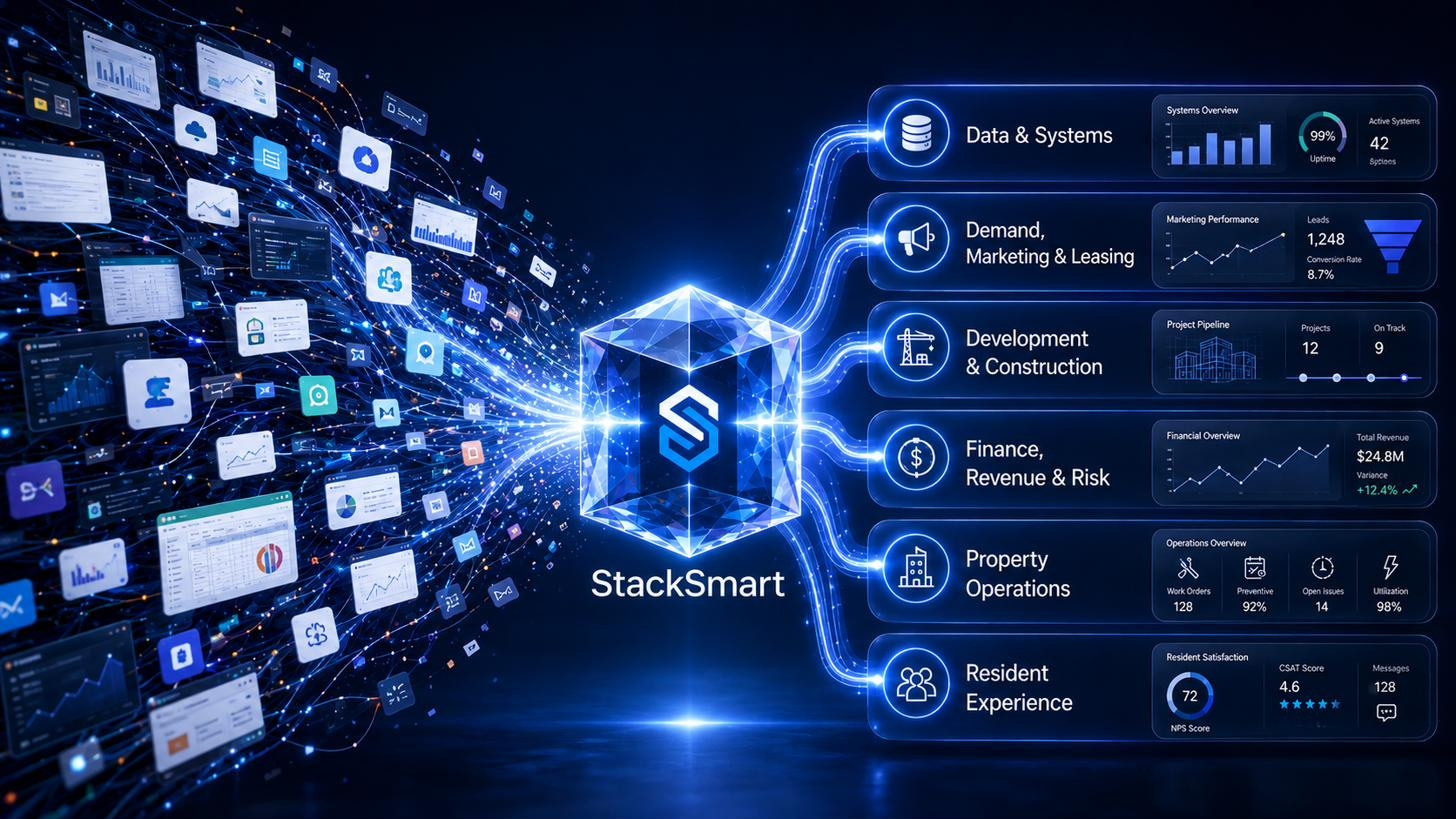
Everything you run, pulled into one place and sorted into the domains you operate in.
This is not a failure of management. It is what happens to any portfolio that grows. A fee manager takes on an assignment and inherits whatever the prior operator was running. An owner-operator buys an asset and buys its contracts with it. Every one of those decisions was reasonable for the person who made it, for a portfolio that no longer exists.
A neutral read tells you which inherited decisions are worth keeping, which ones are quietly working against you, and what the honest cost of the difference is.
Every vendor, contract and renewal, held in one place you can query directly. What is deployed, what it costs per unit, when it renews, and which assignment it arrived with.
A confidence-scored recommendation engine, built on vendor intelligence aggregated across the industry, tells you with a defensible score what to keep, what to replace, and why.
The judgment, sequencing and stakeholder work software alone cannot do, led by people who have run portfolios at your scale.
We don't make money on referrals to vendors. No placement commissions, no referral fees, no success fees tied to which vendor you choose. Objectivity is our product.
Send us your existing materials, in whatever shape they are in. Every page is read, the terms are pulled out, and each document is assigned against your actual operating structure.
The people who use each tool day to day tell us what they think of it. Where the documents contradict what you told us, the software surfaces it and asks. You get a documented view of what to change, in what order, and why.
Where the paperwork disagrees with what you told us, the software raises it rather than quietly picking one.
Findings on their own are not a plan. Everything we surface sorts into four buckets and then ranks, because for a portfolio absorbing change on a rolling basis the ordering matters more than the findings. It is what makes the work fundable and scheduled instead of overwhelming.
Service lines shown are illustrative.
A property management company faces three real decisions: keep what you have, add where you have nothing, or move from one vendor to another. Each recommendation lands as a Case Card, a one-page executive read, with the full Stakeholder document behind it. Here is a worked example of each, in full.
Maintenance Management and Work Orders
You already have the right answer. Here is the proof, and what it was tested against.
Read the full documentInsurance Programs and Resident Risk
You have nothing here at all. Here is what the gap costs, and what to put in.
Read the full documentIdentity, Income Verification and Fraud Prevention
You have something and it is the wrong thing. Here is the case for leaving, and what leaving takes.
Read the full documentOnce your stack is loaded, you can ask it anything, in plain language. Alongside it sits a vetted library of multifamily products and services, open to everyone on your team who needs it.
Alerts on renewals and expirations, custom views by owner, fee manager, region or property, and change tracking on everything.
Every vendor in the library carries the same 20 sections, 18 to 33 pages.
The same structure for every vendor, so two products in the same category can be compared line for line rather than by impression.
Six months later your portfolio may look different. We reassess it, identify what has changed, and refresh the recommendations, including agreements signed since the last review. Two passes a year, both in the rate.
You have the strategy and the roadmap. Choose the direction, and we run as much of the execution as you want us to, so every incoming vendor arrives fully briefed and ready to launch across the portfolio.
One current picture of what each community runs on turns every transition into a known quantity instead of a discovery exercise.
Knowing what is committed and when it comes up is the difference between negotiating and renewing by default.
Every tool that arrives with a property is another vendor with access. A full inventory is what any serious risk posture depends on.
Getting close to one operating system, and managing the fringe cases deliberately, is what lets your standard travel with you.
Most of what we would tell you is already knowable. It just sits in too many places for anyone inside the business to assemble while also running it.